
Elo Variance Explained
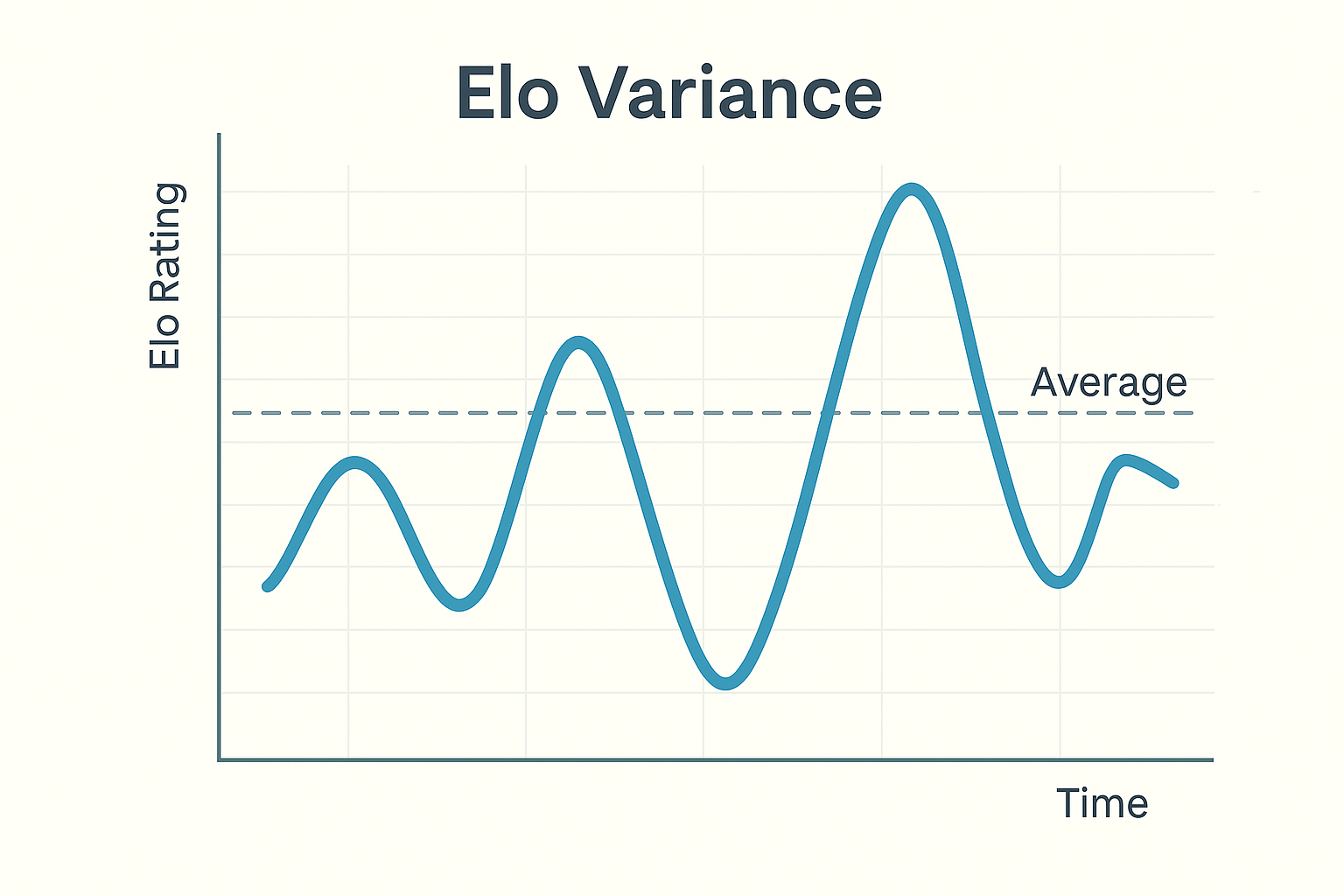
Variance is one of the least understood yet most impactful forces behind Elo rating fluctuations. While many players view their rating as a fixed reflection of skill, the truth is more dynamic: ratings rise and fall not only because of performance differences but also due to statistical variance built into the system.
Understanding how variance works — and how to manage it — is essential for developing a healthier relationship with your Elo progression and making long-term improvement more predictable.
What Is Variance in Elo?
Variance refers to the natural deviation between expected results and actual results. In chess ratings, it represents how unpredictable outcomes can be from game to game, even when skill levels remain stable.
Key sources of variance:
- Human factors: fatigue, stress, concentration lapses
- Style clashes: tactical vs. strategic mismatches
- Time control volatility: faster time controls amplify randomness
- Small sample size: fewer games → more unpredictable ratings
- K-factor sensitivity: higher K means higher variance
Variance is not an error — it is a statistical property of competitive environments.
Why Elo Fluctuates Even When Skill Does Not
Elo assumes players perform close to their average strength. But in reality, performance varies from day to day. A single oversight or stroke of brilliance can shift results far from expectations.
How variance interacts with the system:
- Unexpected loss → larger downward swing
- Unexpected win → larger upward swing
- Streaks (good or bad) → exaggerated rating movement
- Strong opponents → higher volatility when results deviate from expected value
Even top players regularly experience swings of 15–30 points in classical chess due to variance alone.
Variance Across Time Controls
Classical Chess
Lowest variance: more time reduces randomness. Ratings generally stabilize after enough games.
Rapid
Moderate variance: reduced calculation depth increases tactical error rate.
Blitz
High variance: fast decision-making amplifies human inconsistency.
Bullet
Extreme variance: ratings often resemble swings rather than trends.
How to Manage Elo Variance
While you cannot eliminate variance, you can minimize its impact.
1. Play Consistent Time Controls
Jumping between Blitz, Rapid, and Classical creates rating noise. Stick to one main discipline if you want a stable trend.
2. Avoid Playing When Tilted or Fatigued
Emotional instability massively increases short-term variance, often causing steep rating drops.
3. Focus on Volume — But Not Excessively
More games reduce the influence of outliers, but too many games in one session spikes fatigue.
Ideal: several sessions per week, moderate length.
4. Analyze Patterns Across Many Games
You can’t draw conclusions from one bad game — or even five. Look for trends across:
- 30+ blitz games
- 10+ rapid games
- 5+ classical games
5. Accept Natural Fluctuations
A 40–60 point wavering range is normal for most players. What matters is the long-term average, not the immediate snapshot.
Psychological Approaches to Handling Variance
Variance affects not only ratings but also mindset. Players often:
- Panic after a drop
- Overestimate sudden improvements
- Form conclusions too quickly
- Chase lost points emotionally
To counter this:
- View Elo as a statistical estimator, not a personal label
- Track rating ranges instead of absolute peaks
- Separate “rating goals” from “skill goals”
When Variance Misleads Players
False Decline
A downswing is interpreted as getting weaker, even if skills are unchanged.
False Improvement
A rating spike feels like leveling up — but may just be luck or favorable pairings.
Overadjusting
Players may change openings or training plans based on temporary variance-driven noise.
Rating Systems That Model Variance Better
Elo assumes constant volatility, but modern systems attempt to capture variance explicitly.
Glicko
Introduces Rating Deviation (RD) to measure uncertainty.
Glicko-2
Adds volatility, allowing the system to adjust how “swingy” a player’s performance is.
Online Hybrids
Platforms combine Elo, Glicko, and heuristics to reduce sharp distortions.
Conclusion
Variance is not your enemy — it is a natural component of competitive rating systems. Understanding it empowers players to interpret their Elo trends accurately, stay emotionally grounded, and focus on meaningful improvement rather than short-term fluctuations.
By embracing variance and managing its effects, you set yourself up for consistent growth, clearer training decisions, and a healthier relationship with your rating.
Leave a Reply