
ELO Rating in Online vs. Over-the-Board Chess: Key Differences
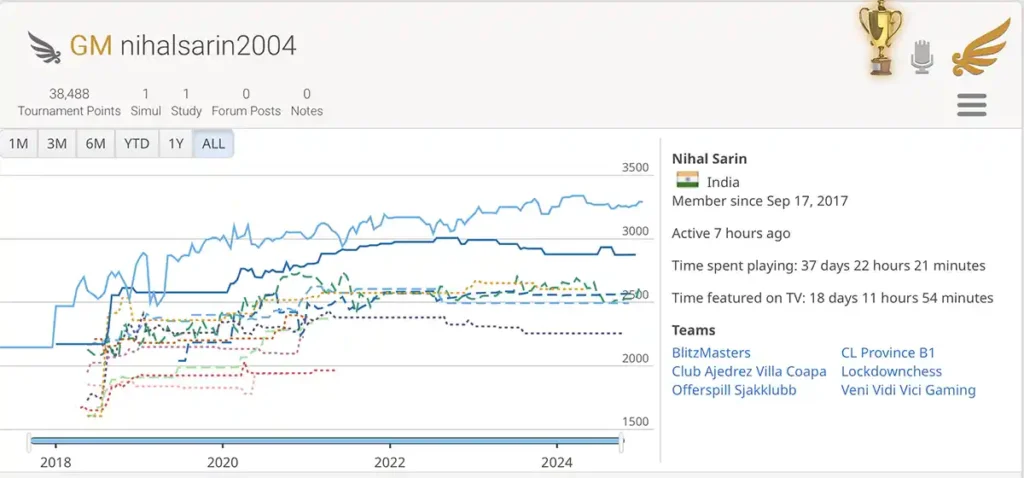
The ELO rating system has been the gold standard for ranking chess players for decades. Whether you’re competing in a local over-the-board (OTB) tournament or playing online, your ELO rating is a reflection of your chess strength. However, there are significant differences in how ELO ratings work between these two environments. Understanding these differences is crucial for improving your performance and managing your expectations across both formats.
1. Pace of Play and Time Control
One of the most obvious differences between online and OTB chess is the pace at which games are played.
- Online Chess: Typically features a wide variety of time controls, with fast-paced formats like bullet (1 minute per player) and blitz (3-5 minutes per player) being popular. The quick time controls can lead to more mistakes, meaning ELO ratings for online blitz games can fluctuate wildly.
- Over-the-Board Chess: Generally has longer time controls, with classical formats allowing hours for a single game. This slower pace enables more accurate calculation and deeper strategy, leading to more stable ELO adjustments.
Key takeaway: Online ELO ratings, particularly for fast time controls, tend to be more volatile compared to OTB ratings due to the faster, more error-prone nature of the games.
2. Player Environment
The environment in which a game is played can significantly impact a player's performance and, subsequently, their ELO rating.
- Online Chess: Played in a comfortable, familiar setting—your home, a café, or anywhere with internet access. However, online distractions like notifications or multitasking can impact focus and lead to poorer performance. Additionally, mouse slips (accidental clicks) can result in blunders that wouldn't occur in OTB play.
- Over-the-Board Chess: Takes place in more formal, tournament-like settings with fewer distractions. The physical interaction with the board and pieces also enhances concentration and reduces the likelihood of accidental mistakes.
Key takeaway: OTB games provide a more controlled environment, which may lead to more accurate representation of a player’s true skill compared to online games, where distractions and technical issues can affect performance.
3. Cheating Concerns
Cheating is a significant issue in online chess, and it directly impacts ELO ratings.
- Online Chess: Despite anti-cheating software, online chess remains vulnerable to cheating with the use of chess engines. This can artificially inflate a player's ELO, leading to a skewed ranking system. Platforms like Chess.com and Lichess employ sophisticated algorithms to detect cheating, but no system is perfect.
- Over-the-Board Chess: Cheating is much harder in OTB chess due to the physical presence of arbiters and spectators. While there have been some high-profile cheating cases, the risk is far lower compared to online play.
Key takeaway: ELO ratings in online chess may not always accurately reflect a player’s skill due to the risk of engine-assisted play, while OTB ratings tend to be more reliable in this regard.
4. Rating Pools and Competition Levels
The pool of players that contribute to your ELO rating is different for online and OTB chess, which affects the overall rating dynamics.
- Online Chess: The sheer number of players participating in online platforms is enormous, leading to a more diverse rating pool. You’re likely to play opponents from all over the world, at all skill levels, making the competition unpredictable.
- Over-the-Board Chess: OTB tournaments tend to attract more serious players, especially at the higher levels. This often means that the quality of competition is more consistent, and achieving a high ELO rating in OTB chess may require more effort compared to online play.
Key takeaway: Online chess has a much larger and more varied player pool, while OTB chess features a smaller, more elite group of players, making the journey to a high rating more challenging.
5. ELO Inflation and Deflation
The phenomenon of ELO inflation and deflation occurs differently in online and OTB chess due to the distinct nature of the player bases.
- Online Chess: With millions of players, including casual and new players, online chess is prone to ELO inflation. As new players enter and lose games, it boosts the ratings of established players, sometimes creating artificially high ratings, especially at the lower levels.
- Over-the-Board Chess: OTB ELO ratings tend to be more stable. Most players participating in OTB tournaments are serious competitors, and new players don’t enter the system as frequently, leading to more consistent ratings and less inflation.
Key takeaway: Online ELO ratings can be subject to inflation, particularly in casual or fast time controls, while OTB ratings tend to be more accurate and consistent over time.
6. ELO Calculation Differences
While the fundamental formula for ELO calculation is the same in both online and OTB formats, there are small differences in how the ratings are calculated by various platforms and organizations.
- Online Chess: Platforms like Chess.com, Lichess, and Playchess use modified versions of the ELO system. Some incorporate additional factors such as activity levels, provisional ratings, and time control differences, which can lead to slight variations in rating calculation across platforms.
- Over-the-Board Chess: FIDE, the international chess federation, uses a standard ELO formula that is universally applied to all classical chess games. This consistency in calculation makes OTB ELO more reliable for tracking long-term progress.
Key takeaway: ELO ratings are calculated slightly differently across online platforms, which can lead to discrepancies between your online and OTB ratings, even if you’re playing at the same skill level.
7. ELO on Chess.com vs Lichess
While the basic principles of ELO rating are consistent, different platforms handle their rating systems slightly differently, leading to variations in players' ELO scores.
- Chess.com: Uses a modified ELO system and separates ratings based on time control (bullet, blitz, rapid, and classical). New players start with provisional ratings, and their ratings adjust more quickly in the early games to reflect their true skill level.
- Lichess: Similar to Chess.com, Lichess separates ratings for different formats (bullet, blitz, classical, and puzzles). However, Lichess uses the Glicko-2 system, which incorporates a “rating deviation” (RD) to measure the uncertainty of a player’s rating. This means that Lichess ratings might fluctuate more in the beginning but become more stable as a player competes in more games.
Key takeaway: Your ELO rating may differ between Chess.com and Lichess even if you play at the same skill level due to their rating systems' variations.
Conclusion
Both online and over-the-board chess offer unique experiences, and each environment affects your ELO rating in different ways. Online chess is faster, more accessible, and has a larger player base, but its ratings can be more volatile and susceptible to cheating. OTB chess, on the other hand, provides a more controlled, serious environment with stable, reliable ratings.
Understanding these differences will help you better manage your expectations and improve your performance in both formats. Whether you’re focused on climbing the online leaderboards or improving your OTB ELO, each setting provides valuable opportunities to sharpen your skills.
Leave a Reply